Showing posts with label Science Friction Stories. Show all posts

Mathematics Tips

Story :
Below mentioned are some magical tips to solve mathematical ques:

Multiply Up to 20X20 In Your Head
In just FIVE minutes you should learn to quickly multiply up to 20x20 in your head.  With this trick, you will be able to multiply any two numbers from 11 to 19 in your head quickly, without the use of a calculator.
I will assume that you know your multiplication table reasonably well up to 10x10.
Try this:
  • Take 15 x 13 for an example.
  • Always place the larger number of the two on top in your mind.
  • Then draw the shape of Africa mentally so it covers the 15 and the 3 from the 13 below. Those covered numbers are all you need.
  • First add 15 + 3 = 18
  • Add a zero behind it (multiply by 10) to get 180.
  • Multiply the covered lower 3 x the single digit above it the "5" (3x5= 15)
  • Add 180 + 15 = 195.
The 11 Rule
You likely all know the 10 rule (to multiply by 10, just add a 0 behind the number) but do you know the 11 rule? It is as easy! You should be able to do this one in you head for any two digit number. Practice it on paper first!
To multiply any two digit number by 11:
  • For this example we will use 54.
  • Separate the two digits in you mind (5__4).
  • Notice the hole between them!
  • Add the 5 and the 4 together (5+4=9)
  • Put the resulting 9 in the hole 594. That's it! 11 x 54=594
The only thing tricky to remember is that if the result of the addition is greater than 9, you only put the "ones" digit in the hole and carry the "tens" digit from the addition. For example 11 x 57 ... 5__7 ... 5+7=12 ... put the 2 in the hole and add the 1 from the 12 to the 5 in to get 6 for a result of 627 ... 11 x 57 = 627
The 11 Rule Expanded
You can directly write down the answer to any number multiplied by 11.
  • Take for example the number 51236 X 11.
  • First, write down the number with a zero in front of it.
051236
The zero is necessary so that the rules are simpler.
  • Draw a line under the number.
  • Bear with me on this one. It is simple if you work through it slowly. To do this, all you have to do this is "Add the neighbor". Look at the 6 in the "units" position of the number. Since there is no number to the right of it, you can't add to its "neighbor" so just write down 6 below the 6 in the units col.
  • For the "tens" place, add the 3 to the its "neighbor" (the 6). Write the answer: 9 below the 3.
  • For the "hundreds" place, add the 2 to the its "neighbor" (the 3). Write the answer: 5 below the 2.
  • For the "thousands" place, add the 1 to the its "neighbor" (the 2). Write the answer: 3 below the 1.
  • For the "ten-thousands" place, add the 5 to the its "neighbor" (the 1). Write the answer: 6 below the 5.
  • For the "hundred-thousands" place, add the 0 to the its "neighbor" (the 5). Write the answer: 5 below the 0.
    That's it ... 11 X 051236 = 563596
Finger Math: 9X Rule

To multiply by 9,try this:
(1) Spread your two hands out and place them on a desk or table in front of you.
(2) To multiply by 3, fold down the 3rd finger from the left. To multiply by 4, it would be the 4th finger and so on.
(3) the answer is 27 ... READ it from the two fingers on the left of the folded down finger and the 7 fingers on the right of it.

This works for anything up to 9x10!
Square a 2 Digit Number Ending in 5
For this example we will use 25
  • Take the "tens" part of the number (the 2 and add 1)=3
  • Multiply the original "tens" part of the number by the new number (2x3)
  • Take the result (2x3=6) and put 25 behind it. Result the answer 625.
Try a few more 75 squared ... = 7x8=56 ... put 25 behind it is 5625.
55 squared = 5x6=30 ... put 25 behind it ... is 3025. Another easy one!

Square 2 Digit Number: UP-DOWN Method
Square a 2 Digit Number, for this example 37:
  • Look for the nearest 10 boundary
  • In this case up 3 from 37 to 40.
  • Since you went UP 3 to 40 go DOWN 3 from 37 to 34.
  • Now mentally multiply 34x40
  • The way I do it is 34x10=340;
  • Double it mentally to 680
  • Double it again mentally to 1360
  • This 1360 is the FIRST interim answer.
  • 37 is "3" away from the 10 boundary 40.
  • Square this "3" distance from 10 boundary.
  • 3x3=9 which is the SECOND interim answer.
  • Add the two interim answers to get the final answer.
  • Answer: 1360 + 9 = 1369

Multiply By 4
To quickly multiply by four, double the number and then double it again.
Often this can be done in your head.

Multiply By 5

To quickly multiply by 5, divide the number in two and then multiply it by 10.  Often this can be done quickly in your head.

Few Facts about Bihar

Story :
Story:
About Bihar: Do you know that...

Bihar has more number of Literate than Kerala and Tamil Nadu combined?

Bihar has more number of Graduate than Andhra Pradesh and Kerala combined?

More Biharis are doctors than Punjab and Gujarat combined?

Bihar has produced more number of IAS officers than Kerala, Karnataka, Tamil Nadu , Andhra and Gujarat combined?

More Biharis are bank probationary officers than any other state?

More Biharis are in IIT compared to Maharashtra and Gujarat?

Murder rate in Bihar is half of the murder rate in Mumbai?

Rape in Bihar is 1/10th of Delhi?


Number of people killed in Bihar in communal violence is 1/75 th
of Gujarat?

Naxalites in Bihar have killed less people than in Andhra Pradesh?


Bihar produces more wheat than Punjab?

Bihar is the only large state where no farmer has committed suicide?

More Bihari Girls complete Graduation than Kerala

Thats Bihar! ...

The Wright Way

Story :
We often receive letters from young people or their parents asking where the best opportunities for the future lie. Our answer is that special oppor­tunities do not exist in the particular industry or profession - they exist within men themselves.

Wrights     On December 17, 1943 the world celebrated the 40th anniversary of the first successful flight of a self­powered airplane - and I can think of no better time to review some of the highlights in the early career of the inventors­ the Wright broth­ers. After you have heard the simple story of their lives - I wonder if you will think they were conscious of what Destiny had in store for them?

     Wilbur Wright was born on a farm near Millville, Indiana - in 1867 - and Orville was born four years later in Dayton, Ohio. Their father was the Reverend Milton Wright. In this period - just after the Civil War - there were yet no electric lights, telephones or auto­mobiles, and their home town, Day­ton, was a typical American town of about thirty thousand people. The Wrights were not wealthy people and the boys had no special advantages, except their home en­vironment. Their parents encour­aged them to investigate whatever aroused their curiosity, but urged them to try to earn enough to cover the costs of their experiments. The boys tried many things,Wright Shop and to fi­nance their experiments they sold kites, folded papers, and collected junk. When bicycles became the fad, the Wright boys each saved up enough money to buy one. This was a new field to them and, after a thorough job of investigation, they went into the bicycle business. Business grew; they not only sold several makes but repaired them, and in 1895 even brought out a custom model of their own make - the Van Cleve.

As they read scientific papers, they ran across an article on Lilien­thal's glider experiments in Ger­many. So they got together all the information they could find about Lilienthal and his work - they in­vestigated Chanute's experi­nents - and read about Langley. But the Wrights could never be satisfied just readi­ng about these experiments - they had to try things for themselves.

Kitty Hawk     They didn't let the fact that Lili­enthal and Pilcher had been killed - or that Chanute had quit after a careful study and many experi­ments in gliding - prevent them from going ahead. They wanted to fly! The Wright boys - in 1899 - be­gan with a biplane kite equipped with wing controls. It is interesting to note that their first man-carrying kite cost them, in actual cash out­lay, about $15.00. As the result of a letter to Chanute - and Weather Bureau reports - they decided to go to Kitty Hawk, North Carolina, for their first experiments.

     You probably know the story from then on - how they made glider after glider - how they fought the weather - about their accidents­ and their inaccurate data. During the next two years, they visited Kitty Hawk with new wings, new controls - and collected fact after fact - until in 1902 they felt they had enough information to build a power machine. Then began another long year's experiments on engines; they found there was none in existance that met their requirements.


Wright Plane     On December 17, 1903, after many disappointments and weeks of wait­ing, they made the world's first suc­cessful flight of a self-powered, heav­ier-than-air flying machine. Orville was the pilot. The flight lasted 12 seconds.

     These few highlights in the early life of the Wright brothers can give only a sketchy impression of those two American pioneers. Perhaps they weren't ordinary boys - al­though there was certainly nothing unusual about their environment. They did not have wealth, family influence nor educational advant­ages. To me they seemed average American boys from an average American town. But they had out­standing qualities - curiosity, per­sistence, an intense desire to succeed and, above all, they were self-suffi­cient. They were encouraged to de­velop themselves from within and not expect too much help from with­out.

     I believe if these young people who write us every year would take the same point of view, they could solve many of their own problems. I don't believe anyone outside should tell them they should be lawyers, doctors or engineers or ad vise them what business to get into. Suppose someone had insisted that the Wright boys get into the new automobile business - the development of the airplane might have been delayed for decades. Certainly no one, at that time, could have advised them to investigate the airplane business - there simply wasn't any.
     
  A young man starting out today should analyze his own problems, prepare himself, perfect his think­ing - and be ready and willing to face the inevitable failures and discouragements. I would not de­pend too much on a fairy god­mother pointing out the Road to Success. I would be more inclined to do some surveying and map making of my own.

Inventor - Business Man

Story :
lOn a warm August day in 1807 a large crowd of people lined the banks of the Hudson River not far from where I am now speaking. They had been told they would see the first trip of a boat without sails. And the skeptics, as usual, were there laughing at the strange looking craft, and ridiculing the idea it could move without sails or oars.

Clermont     But presently smoke began to pour from the stack and the catcalls and ridicule changed to cheers as the weird looking boat moved slowly up the river. Robert Fulton, that day, successfully accomplished something that Fate rarely permits an inventor to do - he proved his idea was practical and at the same time opened up a large part of America to pioneers and settlers.

     Robert Fulton did not begin his career as an inventor; very few men ever do. Although in his youth in Lancaster, Pennsylvania he exhibited considerable mechanical ingenuity, his ambition was to become an artist like another Pennsylvanian, Benjamin West. West was the great American painter who later became president of the Royal Academy of England. So, at seventeen, Fulton went to Philadelphia to study painting. Benjamin Franklin helped him and very soon he earned a reputation as a painter of portraits and landscapes. He could also make excellent drawings of machinery, bridges and buildings.

   When he was twenty-one his doctor advised him to go abroad for his health so he took this opportunity to join his old friend Benjamin West in England. As a protegĂ© of West's, he soon had more requests for portraits and landscapes than he could paint. But as time went on he found himself drifting more and more into mechanical projects. He designed a mill or sawing marble, a flax spinning machine and a canal dredger.

Fulton     Fulton disliked war and he had the unique idea that the way to end wars would be to destroy all warships in existence, and do it as quickly as possible. So he designed a torpedo and later built the submarine Nautilus, adapting some of the ideas, no doubt, of a contemporary, David Bushnell. While in France in connection with the submarine he made the acquaintance of Robert Livingston, then United States minister to France.

     Livingston, with his brother-in-law, Colonel Stevens, and Nicholas Roosevelt had built several unsuccessful steamboats in America, yet they were still enthusiastic about the possibilities of steam navigation. Livingston and Fulton became close friends and in 1804 built a steamboat model - but the engine was so heavy that it quickly sank to the bottom of the River Seine. It was later raised and after many changes it worked fairly well, but above all, it convinced the two men that a successful full scale steamboat could be made.


Waterway     Now they turned their attention to their native land, America, because it was there that the real need for such a means of transportation existed. This was the America after the Revolution - a land of restless people, people who saw millions of acres of virgin soil to the west - separated from markets only by poor transportation. All they had were narrow mountain trails and rivers which could be navigated only down-stream by rowboats and barges. Fulton and Livingston could visualize hundreds of steamboats transporting thousands of people and tons of goods and produce up as well as down those waterways. Livingston would supply the finances - Fulton the ingenuity - an excellent, and very necessary combination.

     Fulton did not invent the Clermont as a flash of genius. In fact, the steamboat, like the automobile, was not a single invention but a combination of many. These ideas did not occur all at once - they were the result of experience and evolution. Many men made essential contributions. One group, including Newcomen and Watt, had evolved the steam engine. Another group made up of Symington, Rumsey, Fitch, Stevens and Robert Fulton contributed the ideas for harnessing the steam engine to the boat.

     Fulton had a combination that those who preceded him did not possess. He had excellent mechanical ability and, being an artist, he was able to clearly draw all the structural details. He also had the financial backing of Livingston and then there was the crying need of the times for just such a means of transportation. In addition to all this, Fulton possessed the ability to coordinate all of these factors in such a practical way that people could easily see their great value and willingly supplied means for their development.


Liner     The skill of Fulton and the confidence of Livingston are some of the reasons why on that August day in 1807 the ridicule turned to cheers when the Clermont steamed up the Hudson. And the thousands of inventors and their financial backers that followed are some of the reasons why the original thirteen states became forty-eight, and why our nation became one of the richest and most powerful in the world. 

A Veterinarian "Shoes" a Horseless Carriage

Story :
Today we are surrounded by so many highly developed products, such as the electric light, the radio, the telephone and the automobile, that we are apt to forget how we came by them. They are so interwo­ven into our daily lives that we over­look their importance until some­thing threatens to deprive us of their use.

TricycleTake th
e automobile, for instance. Until now, very few of us really ap­preciated how much the operation of cars, buses and trucks depended upon gasoline and rubber tires. While our thirty million pneumatic-tired vehicles today have the capacity to move every man, woman and child in the United States at the same time, yet there was not even a pneu­matic bicycle tire on the market sixty years ago.

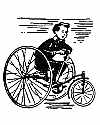
But, thanks to Charles Goodyear, bicycles did have solid rubber tires. In Belfast, Ireland, in 1884, some of the streets were paved with what we call Belgian block, not exactly a smooth road for solid-tired bicycles. Every day, a small boy rode his hard­-tired tricycle over these blocks to school and complained to his father about the roughness. His father, Doctor John Dunlop, a veterinari­an, decided to do something about it. He made a wooden disc wheel, and around the edge of it fastened an inflated rubber tube held in place with linen cloth tacked to the wheel.

To compare the relative speeds of these two tires, the air disc one and the old solid tire, Dunlop rolled them across his yard. The new air tire went the whole length of the yard and bounced off the wall at the end. The solid tire did not go nearly as far.

And so from that time on, his son Johnny would have nothing but the new air tires on his tricycle "because he could beat the bigger boys." But Dunlop then did not have the slight­est conception of the automobile. He didn't rate the pneumatic tire as a scientific invention, but only as something to please a small boy.

In England at that time, bicycle racing had become one of the most popular sports. Everyone was inter­ested in anything that would in­crease the rider's speed. As an ex­periment, Dunlop equipped one of the new "Safety" bicycles with his pneumatic tires, and William Hume, who was not one of the best riders, defeated all the solid-tired competi­tors in his first race. Among the de­feated riders was Harvey DuCros. Arthur DuCros, learning of his brother's defeat, investigated the new tires and had them put on their new "Safety" bicycles. The follow­ing year, he and Harvey won all of the English and French races on their Dunlop tires.

AutoBut people were not exactly convinced, so when news about these revolutionary tires began to travel, the "Irish Cyclist," a trade journal, made these sarcastic comments: "Pneumatic? Something to do with ai
r, isn't it? Quite right, too, we like to see new ideas well ventilated." But Dunlop did not let such criti­cism or the more practical difficulties discourage him. In 1890, through the help of the DuCros, the Pneu­matic Tyre Company was formed and the new tires soon became stand­ard on nearly all English and Ameri­can bicycles.


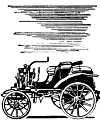
But a new type of vehicle was com­ing into the picture - the automo­bile. And, like the bicycle, these early horseless carriages were usually bought by sportsmen. This was par­ticularly true in France. Michelin, the French rubber manufacturer, learning how successful the pneu­matic tire was in increasing the speed of bicycles, tried for several years to in­terest the automo­bile manufacturers in France in this new type of tire for their faster cars. At last, he con­vinced some of the French makers, and in 1895, the pneumatic tire came into regular use on automobiles.


The story of Dunlop's develop­ment is no different from the expe­riences of many other inventors. It simply is impossible to determine the ultimate value of any invention at the time it is made.

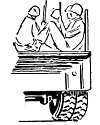
It would be just as difficult for parents to predict the exact future of their new­born child. Dunlop could not foresee that an entirely new in­dustry would come from his invention, to say nothing of his being able to establish it as one of the most important factors in a World War fifty years later.


Army TruckThere are always thousands of young ideas growing up around us. Like children, they must be carefully developed. I am so positive of this that I have often said we must ob­tain a better understanding of the way to develop ideas. Because if we tried to rear human children the way we develop infant ideas, we would expect a child of nine months to earn its own living.

Patience and Practice

Story :
In these talks, we have often stressed the value of patience in developing new things because, as a rule, it takes a long time for an idea to grow up. Today, we have an outstanding example of this from the career of a young Russian who over 40 years ago started experiments in aviation which are just now coming into use.

Fifty-five years ago, Igor Sikorsky was born in Kiev, in Southern Russia. Igor grew up in a scientific atmosphere - his father was a professor of psychology and his mother was educated in medicine. His mother greatly admired Leonardo da Vinci and often told her son of the many accomplishments of the great artist, but da Vinci's flying machine designs made an indelible impression on the boy's mind, even though they were made 400 years before.


With this background, it was only natural that in 1908, when he read about the Wright brothers, he resolved to make flying his career, so he began to collect all the information he could find on the subject. He remembered da Vinci's helicopter sketch, and this may have influenced him to work on a machine that would rise vertically.

After reading everything available, he realized he had to do more - he would have to learn first hand about engines and airplanes - he would have to practice, work and practice. So in January 1909, with the financial aid of his sister, he went to Paris where they were experimenting with airplanes. He spent months at the flying fields talking to the experts, particularly Captain Ferber who offered him the following advice: "Don't waste your time on the helicopter - the airplane will be far more valuable." Another expert published an article on the helicopter entitled "The Wrong Way."

But young Sikorsky returned to Kiev with a lot of information, an engine, and a firm determination to build one. In the next two months he built an experimental machine, then the tests and real troubles began. The helicopter frame resembled a large rectangular box - the engine was on one side, the operator on the other. Many detail troubles were encountered and fixed, then the real difficulty showed up - the engine was too small. So he made a second design. A year later the new machine was completed - it would lift itself but not the operator - there were still many problems to be solved.

In the meantime, he also designed and built an airplane. This was ready for test in April, 1910, and although he had never flown a plane before, without hesitation he climbed into the pilot's seat and opened throttle. But he could get into the air only a few feet. Again it was a question of power. He was getting both practice and experience.

Both the helicopter and airplane furnished valuable scientific information but he had to choose now which one he would develop; and as the airplane seemed to offer greater possibilities at the time, he discontinued his helicopter experiments.

Sikorsky built a second airplane, adding more power, and on June 3, 1910 made his first successful flight. His practice was bearing fruit. New models followed - each larger and more powerful, until in 1913, he was ready to fly his latest - a four-engined ship weighing 9000 pounds called the "Grand."

Before the flight, some said that the plane was too heavy to rise from the ground. Others were sure that the plane was too large to be controlled. But regardless of these warnings, a successful trial flight was made. In 1931, after coming to America, he was still in favor of four-engined ships and launched the S-40, the first of the Clipper ships for ocean travel.

But in 1938 his thoughts turned again to the helicopter, for he realized, as is so often the case, his ideas of 1910 were far ahead of the materials and engineering possibilities of that time. Now things seemed to have caught up with the ideas and, in addition, many new developments had come into aviation. So he built the weird looking machine designated the VS-300. The old process began again - experiment, rebuild and adjust. Practice and more practice!


We all have seen some of the results - helicopters landing on shipboard and on water - others landing in a yard, backing and going straight up. The sketch of da Vinci's vitalized by Sikorsky and many others is just now beginning to materialize. We know it may still be a long time before helicopters will be in our back yards, because experience has taught us that much development work is yet ahead - development that must take place after you and I become actual customers.

Orukter Amphibolos

Story :
Once in awhile, someone makes a prophecy that comes true with remarkable accuracy many years later. Tennyson, over 100 years ago in the poem "Locksley Hall," described "The nations' airy navies grappling in the central blue," and Jules Verne had written "Around The World in 80 Days." These men used their imaginations - but their concepts were not factual enough to include things as they are actually happening today. These ideas or predictions though very interesting, usually have to wait a long time until some practical man can give them a physical form. The first concept of an idea is one thing - the working model is another, and as every inventor knows, popular acceptance - still another.

But occasionally we see a fine example of a man's practical thinking that was a century or more ahead of industry. As a case in point, let us take that military vehicle called the "Duck." This unique land and water conveyance has been developed during this war to make possible invasion of enemy territory. Its versatility lies in the fact that it can leave a ship offshore and travel through the water as a boat. Upon reaching the land, it goes ashore and continues its course as a truck - it can go from land to sea just as easily.

Recently, in Philadelphia, thousands of people lined Market Street and the banks of the Schuylkill River to watch a "Duck" travel along the street, slide into the water and proceed up the river. It was an amazing demonstration.


However, just 140 years before the people of Philadelphia had gathered along the same street and river to witness a demonstration of inventor Oliver Evans' strange vehicle which he called the Orukter Amphibolos or Amphibious Digger. Here is his own description of the event. "To show that both steam carriages and steamboats were practicable, I first put wheels to the boat and propelled it by the engine a mile and a half up Market Street and around Center Square to the River Schuylkill. I then fixed a paddle-wheel at the stern and propelled it by the engine down the Schuylkill and up the Delaware sixteen miles leaving all the vessels that were under sail full halfway behind me."


This was not only a demonstration of the first "Duck" but also an exhibition of the first self-propelled vehicle to be built in this country preceding both the locomotive and steamboat by many years. It sometimes happens that men live in an age that has neither the market or production equipment to take advantage of their advanced ideas. Only after the motor boat and the automotive truck had been highly developed did the amphibious vehicle become a practical mechanism.

Oliver Evans was one of those unusual persons who at an early age exhibited an exceptional skill and interest in things mechanical. At the age of 22 he developed a machine for making wire teeth used in carding wool. He also invented an automatic flour mill which processed the flour from the grain to the barrel without its being touched by human hands.


He was also much interested in steam. One day he came across a book describing Newcomen's steam engine which had been developed in England. Newcomen used atmospheric pressure to do the work steam was condensed to produce a vacuum under the piston. Evans however, thought the steam should be used directly. Obsessed with this idea, he designed and built a high pressure engine. Newcomen was interested only in pumping water, but Evans visualized steam power being used to do all sorts of work.


By 1803 he seriously entered the steam engine business, and one of his first jobs was to build a steam dredge ordered by the city of Philadelphia. This was the amphibious vehicle which he demonstrated and described in 1804. Unfortunately Evans was ahead of his time as far as a market was concerned for he found the building and selling of steam engines full of disappointments and financial reverses. A fire destroyed his factory in 1819 and ended his active work, but his contributions along with thousands of others have made this country a great industrial nation.


Evans lived in the days when America was still largely undeveloped. The frontier then was a definite, physical thing to be overcome by whatever tools were available.


Today, the geographical frontier has almost disappeared, but many other frontiers - such as music, science and medicine are as great as ever. We must not only mentally explore these unknown fields by using our imaginations but, in addition to theorizing, we should put some of the advanced ideas into physical form and try them out, for we must build the future on fact as well as on fancy

Share

Twitter Delicious Facebook Digg Stumbleupon Favorites More